
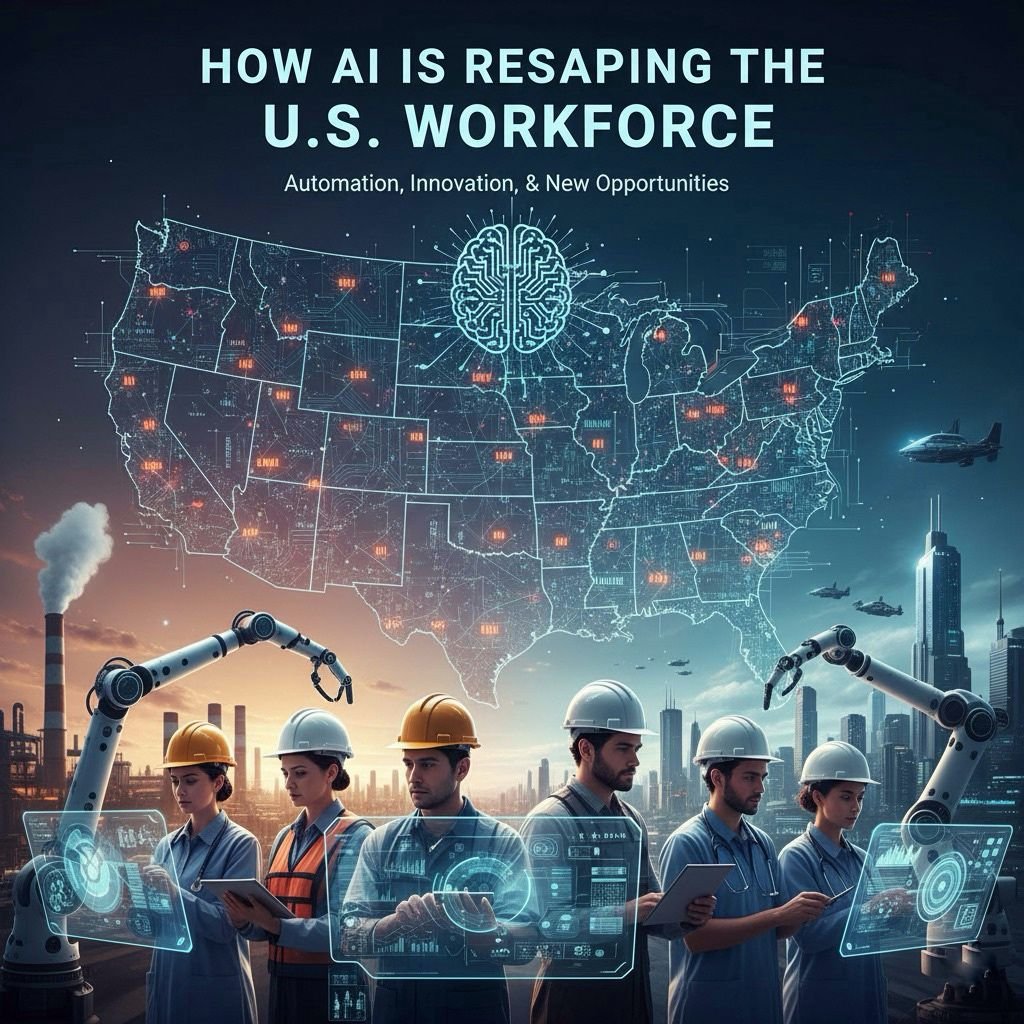
Discover how AI is reshaping the American workplace, creating new jobs, shifting tasks, and highlighting skills needed to thrive today
How AI Is Reshaping the U.S. Workforce: A Seismic Shift Unfolds
Artificial Intelligence is no longer a sci-fi trope or a tool exclusive to tech giants. It has permeated every sector of the U.S. economy, from manufacturing to marketing, healthcare to finance, fundamentally reshaping the future of work at a staggering pace. We are not on the brink of a revolution; the revolution is already here. But is this a warning of AI-driven job displacement, or a harbinger of limitless opportunity? The answer is far more nuanced.
Artificial Intelligence (AI) is no longer just a tech buzzword—it is actively transforming the U.S. labor market. Across industries from finance and healthcare to manufacturing and marketing, AI is redefining how work gets done, the skills workers need, and the types of jobs available. National University

Not Displacement, But Transformation: The Reshaping of Tasks and Roles
Most studies, including landmark reports from McKinsey Global Institute, suggest that while AI will automate some jobs, it will transform many more and create entirely new categories. The real focus isn’t on “jobs” as monolithic units, but on “tasks.”
- Automating Routine Tasks: AI excels at automating repetitive, data-heavy tasks (like data entry, basic processing, scheduling), freeing human workers to focus on higher-value work.
- Augmenting Human Capability: In fields like medical diagnosis, AI tools help doctors analyze radiology images faster and more accurately, making them more effective. In engineering design, generative AI models suggest alternatives, enhancing human creativity.
- Birth of New Professions: We are already seeing rising demand for roles like AI Prompt Engineer, AI Ethics Specialist, Machine Learning Manager, and Human-AI Collaboration Coordinator—jobs that barely existed a decade ago.
- Recent research shows that 23.2 million American jobs already have at least 50% of tasks automated or supported by generative AI technologies—indicating transformation, not wholesale elimination. shrm.org
- AI has the potential to automate or significantly modify up to 30% of U.S. jobs by 2030, with routine tasks being most at risk. National University
- Simulation tools like the Iceberg Index suggest AI could realistically replace about 11.7% of U.S. jobs, worth over $1.2 trillion in wages, though timing and exact roles vary by state and sector. Tom’s Hardware
- Automation vs. Augmentation
- AI doesn’t just eliminate tasks—it augments human work:
- Tasks that are repetitive, data‑intensive, or rule‑based are most likely to be automated.
- Roles requiring human judgment, creativity, emotional intelligence, and leadership are less likely to be displaced and may grow in importance.
- Many workers will see AI tools enhance productivity rather than replace their roles entirely. shrm.org
- New Jobs and Emerging Opportunities
- While some roles are automated, new job categories are emerging:
- AI‑related roles such as AI specialists, machine learning engineers, and AI policy/ethics advisors are growing rapidly.
- Other growing areas include data analytics, cybersecurity, and human‑AI collaboration roles—fields that combine technology with uniquely human skills. National University
The New Skill Set is the Currency of the Future
As the nature of work changes, so do the essential skills for the modern workforce. Adaptability and continuous learning are becoming non-negotiable for employability.
- Specialized Technical Skills: Such as programming, data analysis, and AI system management.
- Irreplaceably Human Skills: These are the skills machines struggle to replicate: critical thinking, creativity, emotional intelligence, leadership, and complex problem-solving. These will be the human competitive advantage.
- AI Literacy: The ability to effectively use and collaborate with AI tools is becoming a core digital literacy skill, regardless of your field.
- Advanced technical skills like programming and data analysis.
- Human‑centric skills such as critical thinking, creativity, and emotional intelligence—areas where AI cannot easily compete.
- Adaptability and lifelong learning, as workers must update skills continuously to stay competitive. National University
Challenges and Ethical Imperatives
This transformation is not without significant hurdles:
- Algorithmic Bias: AI systems can perpetuate biases present in their training data, leading to unfair outcomes in hiring and performance evaluations.
- Inequality: The risk of widening the divide between those with high-tech skills and those without is real. For a deeper dive, see this report from the Brookings Institution on AI’s impact across communities.
- Job displacement and reskilling needs: Millions of workers will need support to transition into new roles.
- Skills gaps between available jobs and workers’ qualifications are widening.
- Economic and social implications, such as effects on wages and job security, will require thoughtful policy and investment in education and training. National University
Adaptation is the Only Path Forward
AI is not an external force to be resisted, but a transformative tool to be harnessed. The future of the U.S. labor market will not be a battle of human vs. machine, but a partnership. Success will favor individuals who embrace a lifelong learning mindset, companies that invest in reskilling their employees, and policymakers who create frameworks for a just transition.
The message is clear: adaptation is not optional; it’s essential. Start today: explore a course in data analytics, experiment with an AI tool that can aid your work, and hone those uniquely human skills that define you. The future is being built now.
Mastering Resumes for the AI-Driven Job Market
You can explore this e-book to learn how to use keywords and their types according to the job you are applying for. The book is highly practical, connecting resumes with ATS systems and explaining the role of Artificial Intelligence and Agentic AI in resume building. It clearly guides the transformation from a traditional resume to what today’s job market demands, especially as we approach 2026, making it a valuable resource for preparing for future employment requirements.