
Skills-based resume 2026 guide: learn how to showcase skills, experience, and achievements to get hired without a four-year degree.
Your Skills Can Be More Valuable Than Your Degree
For years, a four-year college degree has been treated as a default requirement for many US jobs. But the hiring conversation is changing.
More employers are exploring skills-based hiring, where candidates are evaluated according to what they can actually do rather than screened out solely because they don’t have a bachelor’s degree. That shift is good news if you’re a career changer, an experienced worker without a college degree, or an entry-level candidate trying to compete with degree-holders.
The key is knowing how to present your value.
A skills-based resume 2026 strategy doesn’t mean hiding your education or pretending credentials don’t matter. Instead, it puts the strongest evidence of your ability closer to the top of the page. Your skills, accomplishments, tools, projects, certifications, and relevant experience become the center of the story.
That matters because employers aren’t hiring diplomas. They’re hiring people to solve problems, serve customers, operate systems, manage schedules, analyze information, sell products, build relationships, and get work done.
If you can demonstrate those abilities clearly, you have something valuable to put in front of a hiring manager.

This guide explains how to get hired without a degree 2026 style: identify the right jobs, select the right resume structure, translate your experience into measurable skills, and make the finished document easy for both recruiters and applicant tracking systems to understand.
You don’t need to apologize for what isn’t on your resume. You need to make what is on it impossible to overlook.
What Is Skills-Based Hiring (And Why It's Growing in 2026)
Skills-Based Hiring Explained
Skills-based hiring is an approach in which employers place greater emphasis on a candidate’s demonstrated capabilities, competencies, and relevant experience when making hiring decisions.
That doesn’t necessarily mean employers have stopped caring about degrees. Some jobs still require formal education because of licensing, regulation, professional standards, or the technical nature of the work.
However, for many roles, employers can assess whether someone has the required skills through work history, projects, certifications, assessments, portfolios, interviews, and other forms of evidence.
You don’t need to apologize for what isn’t on your resume. You need to make what is on it impossible to overlook.
For job seekers, the distinction is important.
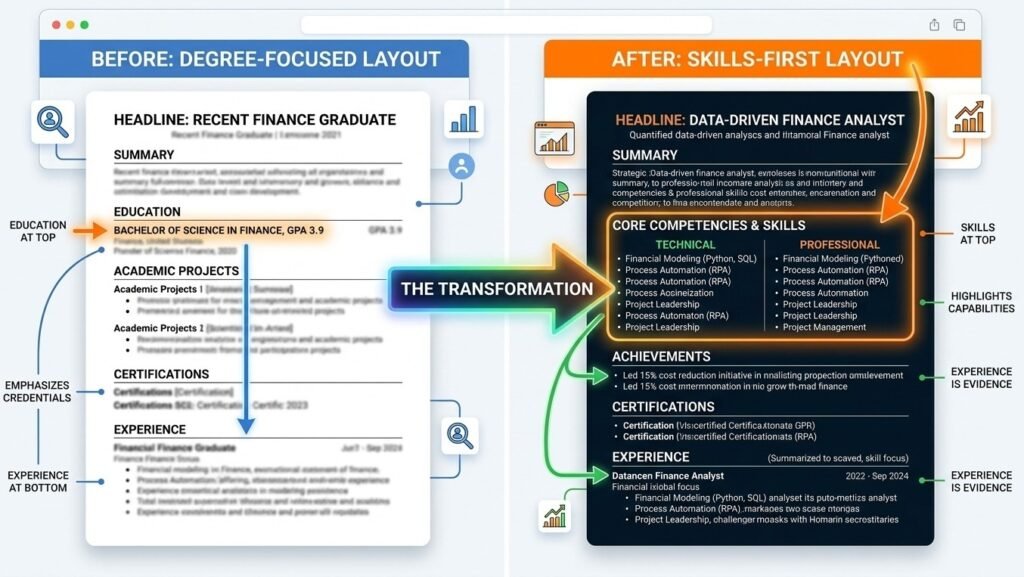
A traditional resume may lead with:
Bachelor’s Degree
University Name
Graduation Year
A skills-first resume can instead lead with:
Customer Service | POS Systems | Inventory Management | Cash Handling | Team Training
The second version immediately tells an employer what the candidate can contribute.
Why Employers Are Paying More Attention to Skills
Hiring managers have a practical problem: job descriptions list responsibilities, but resumes often list job titles.
A title doesn’t always tell the full story.
Someone who worked as a cashier might have experience with payment systems, customer conflict resolution, inventory counts, upselling, opening and closing procedures, and training new employees.
Someone who worked in construction might have experience with project coordination, safety procedures, equipment operation, measurements, scheduling, and quality control.
Someone who spent several years caring for family members may have developed scheduling, budgeting, organization, communication, and problem-solving skills.
Those abilities don’t disappear because they weren’t learned in a classroom.
The challenge is translating them into language that employers recognize.
Skills-Based Hiring Is Not the Same as Removing Standards
There’s an important distinction here.
A company that values skills isn’t necessarily lowering its standards. In many cases, it’s trying to identify qualified people through a wider range of evidence.
For example, a customer support employer might care about:
- Clear written communication
- Problem-solving
- CRM familiarity
- Patience
- Organization
- Product knowledge
- Conflict resolution
If a candidate has demonstrated those abilities, the absence of a bachelor’s degree may be less relevant.
to apologize for what isn’t on your resume. You need to make what is on it impossible to overlook.
Why This Creates an Opportunity for Career Changers
Career changers often face a frustrating problem: their previous job title doesn’t match their desired job title.
But skills can transfer.
A restaurant supervisor may have experience that applies to:
- Operations
- Customer success
- Team leadership
- Scheduling
- Inventory
- Sales
- Training
A warehouse worker may have relevant skills for:
- Logistics
- Supply chain
- Inventory control
- Operations coordination
- Quality assurance
The trick is to stop describing your experience only through the lens of your old industry.
Describe it through the skills that matter in your target industry.
What This Means for Your Resume
Your resume has one job: make the employer want to learn more.
For a non-degree candidate, that means replacing an apology-based mindset with an evidence-based one.
Don’t write:
I don’t have a college degree, but I have worked hard for many years.
Write:
Operations professional with 6+ years of experience coordinating inventory, training employees, resolving customer issues, and improving daily workflow.
The second statement moves immediately toward value.
That is the foundation of a skills-based resume 2026 approach.
How to Know If a Job Is a Good Fit for a Skills-Based Resume
Start With the Job Description
Before changing your resume, study the job posting.
Look at the qualifications section and divide requirements into three categories:
| Requirement | What It Means |
| Required degree | Potential barrier; investigate carefully |
| Preferred degree | May not be an automatic rejection |
| Required skills | Strong opportunity to demonstrate ability |
| Preferred skills | Useful differentiators |
| Required license | Usually non-negotiable |
| Experience requirement | Often replaceable with equivalent experience, depending on employer |
| Portfolio or assessment | Strong opportunity to prove practical ability |
Don’t automatically reject yourself because you don’t meet every preferred qualification.
Employers frequently distinguish between required and preferred qualifications for a reason.
Look for Skills-First Language
A job may be particularly suitable when the posting emphasizes phrases such as:
- Demonstrated ability
- Equivalent experience
- Relevant experience
- Proven track record
- Technical proficiency
- Customer service skills
- Communication skills
- Problem-solving
- Ability to learn
- Portfolio
- Certification
- Work sample
These phrases suggest that demonstrated capability may carry meaningful weight.
Identify the Five Most Important Skills
Don’t try to match every word in the posting.
Instead, identify the five skills that appear most important.
For example, imagine you’re applying for an office coordinator position. The posting emphasizes:
- Scheduling
- Microsoft Office
- Customer communication
- Data entry
- Organization
Those become the foundation of your resume.
If you’ve developed those abilities through retail, hospitality, volunteering, freelance work, or another industry, bring them forward.
Know When a Degree Really Is Required
A resume without a degree can work extremely well for some positions, but it isn’t appropriate to ignore genuine requirements.
Be cautious when a posting requires:
- A professional license
- A legally mandated credential
- A specific degree for regulated work
- Specialized clinical education
- A certification that you don’t possess
- Security or technical credentials required for the role
You can still apply when appropriate, but don’t build your strategy around pretending a mandatory credential doesn’t matter.
Don’t Confuse Job Requirements With Job Preferences
“Bachelor’s degree preferred” is very different from “Bachelor’s degree required.”
If the degree is preferred and you strongly match the experience and skills requirements, consider applying.
If you’re unsure, research the employer’s hiring practices and compare several postings for similar roles.
The goal isn’t to apply everywhere.
It’s to focus your effort where your experience gives you a realistic chance.
How to Write a Skills-Based Resume: 8 Practical Steps
Step 1: Choose a Clear Resume Structure
For most candidates without a degree, a hybrid resume is often more useful than a purely functional resume.
A practical structure is:
- Name and contact information
- Professional headline
- Summary
- Core skills
- Professional experience
- Selected achievements or projects
- Certifications
- Education or training
This structure lets you emphasize skills without hiding your employment history.
A purely functional resume can sometimes make recruiters wonder what the candidate is trying to conceal. A hybrid structure gives you the best of both worlds: skills are visible, but your experience remains clear.
Step 2: Write a Targeted Professional Headline
Your headline should describe the professional value you offer.
Weak:
Looking for a Job
Better:
Customer Service Specialist | POS Systems | Conflict Resolution | Sales Support
Another example:
Operations Professional | Inventory Control | Team Training | Scheduling
Your headline should match the type of job you’re pursuing.
Step 3: Write a Four-Line Summary
Your summary should answer three questions:
- What do you do?
- What are you good at?
- What value can you bring?
For example:
Customer service professional with 5+ years of experience supporting customers, processing transactions, resolving complaints, and training new team members. Skilled in POS systems, cash handling, inventory procedures, and high-volume customer communication. Known for staying calm under pressure and maintaining accurate records.
Notice what’s missing: an apology about education.
Your degree status isn’t the professional summary.
Your value is.
Step 4: Build a Job-Relevant Skills Section
Create a concise skills section using keywords from the target job.
Divide skills into useful categories when appropriate.
Customer Service
- Complaint resolution
- Customer communication
- Service recovery
- Upselling
Operations
- Inventory management
- Scheduling
- Opening and closing procedures
- Quality control
Technology
- POS systems
- Microsoft Excel
- Google Workspace
- CRM software
Only list skills you can honestly discuss in an interview.
Keyword stuffing doesn’t make a resume stronger.
Step 5: Turn Duties Into Achievements
This is one of the biggest differences between an average resume and a strong one.
A duty says what you were assigned to do.
An achievement shows what you actually accomplished.
Instead of:
Responsible for helping customers.
Try:
Assisted 50+ customers per shift, resolved service issues, and recommended products based on customer needs.
Instead of:
Managed inventory.
Try:
Maintained accurate inventory records and completed regular stock counts to reduce product discrepancies.
Whenever possible, include numbers.
Useful measurements include:
- Customers served
- Transactions processed
- Employees trained
- Projects completed
- Revenue supported
- Time saved
- Error reduction
- Inventory volume
- Sales performance
You don’t need a dramatic statistic for every bullet. Even a small, honest measurement can make a bullet more concrete.
Step 6: Include Relevant Experience Beyond Traditional Employment
A skills-based candidate can have more experience than their job history suggests.
Consider including:
- Freelance work
- Volunteer projects
- Personal projects
- Community leadership
- Contract work
- Apprenticeships
- Internships
- Certifications
- Online coursework
- Relevant side businesses
- Technology projects
- Portfolio work
For entry-level applicants, these experiences can provide evidence of ability when formal employment is limited.
If you’re struggling with how to present limited experience, see this guide on writing a resume with no formal experience.
Step 7: Add Certifications and Training
Certifications can help establish specialized knowledge, particularly when the credential is recognized in your target industry.
Examples might include:
- IT certifications
- Project management training
- OSHA-related training
- Customer service certifications
- Bookkeeping credentials
- Software certifications
- Industry-specific licenses
Don’t create a separate “Certificates I Once Took” section containing irrelevant courses.
Focus on credentials that support your target job.
Step 8: Make the Resume ATS-Friendly
Applicant tracking systems can scan resumes for keywords and information before a recruiter reviews them.
Keep your formatting straightforward.
Use:
- Standard headings
- Simple fonts
- Conventional section names
- Job-specific keywords
- Consistent dates
- Clear bullet points
Avoid unnecessary graphics, text boxes, complicated columns, and decorative elements that can interfere with parsing.
For more guidance, follow this ATS-friendly resume guide.
How to Turn Life and Work Experience Into Resume-Ready Skills
Stop Thinking Only in Job Titles
One of the easiest ways to improve your resume is to ask:
“What did I actually have to be good at?”
That’s a better question than:
“What was my job title?”
A job title describes a position.
Skills describe your capabilities.
Example 1: Cashier
Before — vague duty:
Operated cash register and helped customers.
After — skill-focused:
Processed high-volume customer transactions accurately, resolved payment issues, and provided friendly service during busy shifts.
Skills demonstrated: cash handling, accuracy, customer service, problem-solving, working under pressure.
Example 2: Restaurant Worker
Before — vague duty:
Took customer orders and cleaned tables.
After — skill-focused:
Managed customer orders in a fast-paced environment, coordinated with kitchen staff, and maintained service standards during peak periods.
Skills demonstrated: communication, teamwork, multitasking, time management.
Example 3: Warehouse Worker
Before — vague duty:
Loaded trucks and moved inventory.
After — skill-focused:
Prepared and moved inventory for scheduled shipments while following safety procedures and maintaining accurate product counts.
Skills demonstrated: logistics, inventory control, safety, accuracy, time management.
Example 4: Family Business
Before — vague duty:
Helped my family’s business.
After — skill-focused:
Supported daily business operations by handling customer inquiries, tracking orders, organizing supplies, and coordinating appointments.
Skills demonstrated: administration, customer service, organization, order management, scheduling.
Example 5: Volunteer Experience
Before — vague duty:
Helped at a community event.
After — skill-focused:
Coordinated guest check-in, answered attendee questions, and helped organize event materials for a community program serving more than 100 participants.
Skills demonstrated: event support, communication, organization, customer service.
Use the Skill → Action → Result Formula
A simple formula makes rewriting easier:
Skill + Action + Result
For example:
Used Excel to organize weekly inventory data, improving visibility into stock levels for the store manager.
Or:
Trained three new employees on POS procedures, customer service standards, and closing routines.
Or:
Resolved customer complaints by identifying the issue, explaining available options, and completing service recovery.
You don’t need to force a result into every bullet if you don’t have one.
But whenever you can show an outcome, do it.
Think About Transferable Skills
Transferable skills are especially valuable for career changers.
They can include:
- Communication
- Leadership
- Organization
- Sales
- Customer service
- Problem-solving
- Time management
- Teamwork
- Research
- Training
- Negotiation
- Scheduling
- Attention to detail
- Adaptability
The important part is connecting the skill to evidence.
Don’t write:
Excellent communication skills.
Write:
Explained product options to customers, answered questions, and resolved service concerns in a high-volume retail environment.
The second statement proves communication rather than merely claiming it.
Skills-Based Resume Mistakes to Avoid
✅ Do: Match the Resume to the Job
Use the language of the job description when it honestly reflects your experience.
❌ Don’t: Copy the Entire Job Posting
Recruiters can tell when a resume is stuffed with keywords.
✅ Do: Lead With Relevant Skills
Put your strongest job-related abilities near the top.
❌ Don’t: Create a Giant Skills List
A list of 30 skills doesn’t prove proficiency.
✅ Do: Support Skills With Evidence
Show where and how you used the skill.
❌ Don’t: Claim Skills You Can’t Explain
If an interviewer asks about a software program, you should be able to discuss your actual experience.
✅ Do: Keep Your Employment History Honest
You can reframe experience, but don’t inflate job titles or responsibilities.
❌ Don’t: Hide Your Entire Work History
A purely functional resume can make your career path harder to understand.
✅ Do: Use Simple Formatting
Make the document easy to scan.
❌ Don’t: Overdesign It
Graphics and elaborate layouts can distract from your qualifications and create ATS problems.
For more guidance, review these common resume mistakes before submitting applications.
Quick Resume Quality Checklist
| Question | Yes/No |
| Does the headline match my target job? | |
| Is my professional summary specific? | |
| Are my top skills relevant to the posting? | |
| Does each important skill have supporting evidence? | |
| Have I included measurable accomplishments where possible? | |
| Are certifications easy to find? | |
| Is the formatting ATS-friendly? | |
| Did I remove irrelevant information? | |
| Did I proofread dates, names, and contact information? | |
| Can I explain every skill during an interview? |
Avoid the “Functional Resume Trap”
A common mistake is creating a resume that consists almost entirely of skill categories.
For example:
Leadership
Communication
Teamwork
Customer Service
Organization
That looks nice but doesn’t provide enough evidence.
A better approach is:
Team Leadership: Trained and supported new employees on customer service procedures, daily opening routines, and POS operations.
The skill is visible.
The evidence is right next to it.
That’s much stronger.
Frequently Asked Questions
1. Can I get hired without a college degree in 2026?
Yes. Many jobs don’t require a four-year degree, and employers may evaluate candidates using experience, skills, certifications, portfolios, assessments, and interviews. However, requirements vary by occupation and employer, so always distinguish between required and preferred qualifications.
2. What is the best resume format if I don’t have a degree?
A hybrid resume is often a strong option. It gives you room to emphasize relevant skills near the top while still showing your employment history in a clear chronological format.
3. Should I leave education off a resume without a degree?
Not necessarily. If you attended college, completed relevant coursework, earned certifications, or completed vocational training, include information that supports your candidacy. You don’t need to emphasize that you don’t have a four-year degree.
4. How do I write a resume without a degree when I have little experience?
Focus on transferable skills and evidence from every legitimate source available. Include volunteer work, projects, internships, freelance assignments, community activities, certifications, coursework, and part-time employment when relevant.
If your experience is limited, don’t make the resume longer just to fill space. Make each relevant example more specific.
5. Should I use the phrase “skills-based resume 2026” on my actual resume?
No. That’s an SEO keyword for this article, not a phrase you normally need on your resume. Your resume should use professional language that matches your target position.
Instead, use job-specific terms such as “Customer Service,” “Inventory Management,” “Sales Support,” or “Data Entry” when they accurately describe your capabilities.
6. Can a skills-based resume beat a candidate with a college degree?
It can help you compete, but no resume guarantees that outcome. Hiring decisions depend on the job, employer, candidate pool, experience, interview performance, and required qualifications.
Your goal isn’t to prove that degrees don’t matter.
Your goal is to make a strong case that you can do the job.
7. How many skills should I put on my resume?
Focus on relevance rather than a specific number. A concise list of the skills most important to the target position is usually more effective than an enormous inventory.
Prioritize skills you can support with experience or examples.
8. Should I mention that I’m trying to change careers?
You can, but you don’t have to make the career change the headline.
Instead, emphasize transferable skills and relevant accomplishments.
For example:
Customer-facing professional transitioning into customer success, bringing 5+ years of experience in relationship management, problem resolution, sales support, and high-volume communication.
That tells the employer where you’re going and why your background is relevant.
Get Your Free Resume Template →
https://www.serverresume.net/home/templates/
Conclusion: Your Resume Should Prove What You Can Do
Not having a four-year degree doesn’t mean you have nothing to offer.
You may already have years of experience solving problems, helping customers, managing schedules, operating equipment, training coworkers, handling money, organizing information, or keeping a business running.
Those are skills.
The challenge is making them visible.
A strong skills-based resume 2026 strategy starts by identifying employers that value demonstrated ability, studying the job description, selecting your most relevant skills, and backing those skills with specific evidence.
Remember these principles:
- Target the right jobs. Look carefully at required versus preferred qualifications.
- Lead with value. Put relevant skills and accomplishments where recruiters can see them quickly.
- Translate experience. Job duties are less powerful than evidence of what you achieved.
- Use transferable skills. Your previous industry doesn’t define the value of your experience.
- Keep the resume honest. Never invent credentials, responsibilities, or results.
- Make it easy to scan. Clear formatting helps recruiters and applicant tracking systems process your information.
- Apply strategically. You don’t need to meet every preferred qualification to be a credible candidate.
Most importantly, don’t let the absence of a degree become the entire story of your career.
Your resume should tell employers what you can do, what you’ve already done, and how those abilities can help their organization.
That’s the heart of a skills-first resume — and it can give non-degree candidates a much stronger way to compete in today’s job market.
Start with one target job today. Pull out its five most important skills. Then find evidence from your own experience for each one.
That’s how you turn experience into opportunity.
Your next job doesn’t have to be limited by the credential you don’t have. It can be built around the skills you do.
Ready to turn your experience into a stronger application? Start with a targeted resume, tailor it to the job description, and use your strongest skills as evidence of the value you can bring.