
Land your next retail job with our ultimate Resume for a Cashier guide. Discover top skills, resume examples, action verbs, and ATS-friendly keywords to stand out!
How to Write a Professional Resume for a Cashier
Landing a job as a cashier in today’s competitive retail and hospitality market requires more than just knowing how to operate a cash register. Whether you are aiming for a position at a major retailer like Walmart, a high-end boutique, or a busy local grocery store, your resume is your first impression. It needs to communicate accuracy, reliability, customer service excellence, and speed.
This comprehensive guide will walk you through every step of crafting a standout resume for a cashier, from choosing the right format to optimizing it for Applicant Tracking Systems (ATS) used by major employers across the United States.
1. Choosing the Best Resume for a Cashier
Before you type a single word, you must decide how to structure your document. The format you choose depends heavily on your professional background and career goals.
The Reverse-Chronological Format
This is the most popular format in the US job market. It lists your work experience starting with your most recent position and moving backward.
Best for: Candidates with consistent experience in retail or customer service.
Why it works: Hiring managers can immediately see your career progression and recent stability.
The Functional (Skills-Based) Format
This structure prioritizes your skills over your chronological work history. It groups your abilities into specific categories, such as “Cash Handling” or “Customer Relations.”
Best for: Career changers, entry-level applicants, or individuals with employment gaps.
Why it works: It shifts the focus away from where you worked and highlights what you can do.
The Hybrid (Combination) Format
This layout gives equal weight to both your skills and your chronological work history.
Best for: Highly experienced cashiers or head cashiers looking for managerial roles.
2. Writing a Powerful Resume Summary or Objective
Hiring managers spend an average of six seconds scanning a resume before deciding if a candidate is worth interviewing. Your introduction—either a professional summary or a career objective—must grab their attention instantly.
Professional Summary (For Experienced Cashiers)
If you have at least one to two years of experience, use a summary. It should highlight your years of service, key skills, and a quantifiable achievement.
Wrong: Experienced cashier looking for a retail job where I can use my cash handling skills.
Right: Dependable and detail-oriented Cashier with 3+ years of experience in high-volume retail environments. Proven track record of managing up to $5,000 daily with zero variance while maintaining a 98% positive customer satisfaction rating. Expert in POS operations, loyalty program enrollment, and loss prevention.
Career Objective (For Entry-Level or First-Time Job Seekers)
If you are a student or switching careers, focus on your transferable skills, attitude, and how you intend to help the employer succeed.
Wrong: I need a cashier job to gain experience and pay my bills.
Right: Enthusiastic and reliable high school graduate seeking an entry-level Cashier position at Target. Brings strong basic math skills, exceptional communication abilities, and a flexible schedule. Eager to provide fast, friendly checkout service and support team operational goals.
3. Highlighting Your Cashier Work Experience
The professional experience section is the core of your resume. Instead of just listing your daily duties, you should focus on your achievements and use strong action verbs. Employers know that cashiers ring up items; they want to know how well you did it.
How to Structure Your Job Entries
For each position, include:
Job Title (e.g., Lead Cashier, Retail Associate)
Company Name, City, and State
Dates of Employment (Month and Year)
3 to 5 bullet points detailing your responsibilities and achievements
Tailoring Your Bullet Points with Quantification
Numbers speak louder than words on a resume. Whenever possible, include data, percentages, and dollar amounts.
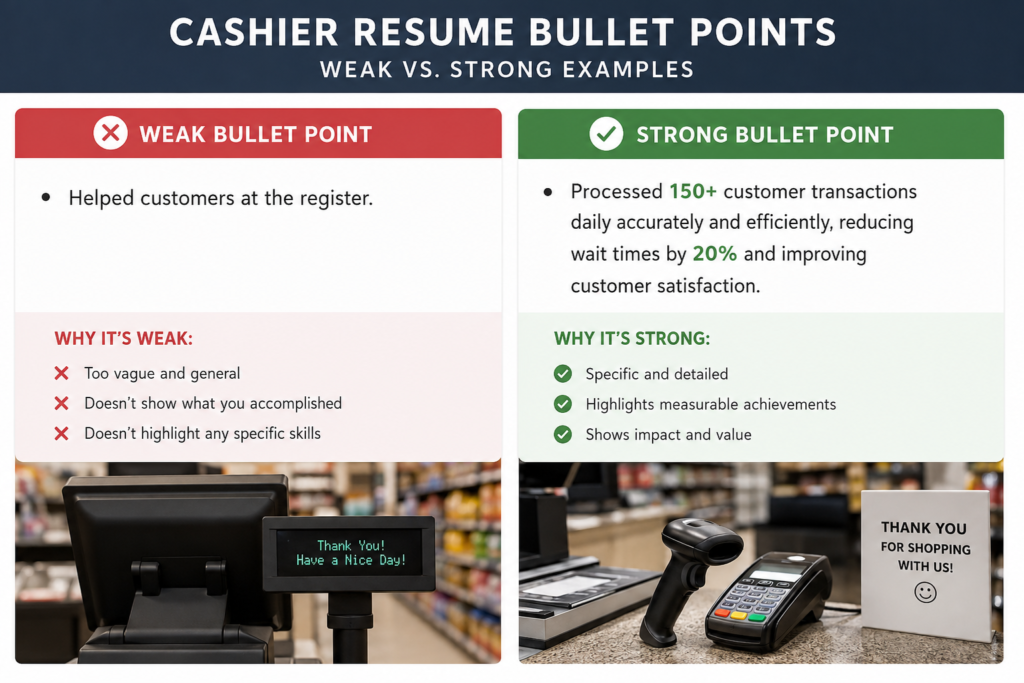
Weak: Responsible for ringing up customers and handling money.
Strong: Processed over 150 customer transactions daily using legacy and cloud-based POS systems with 100% accuracy.
Weak: Helped customers find products.
Strong: Assisted an average of 200+ customers per shift, resolving inquiries promptly and boosting store loyalty program sign-ups by 15% over six months.
Weak: Cleaned the checkout area.
Strong: Maintained a clean, organized, and fully stocked checkout lane, complying strictly with store safety and sanitation guidelines.
4. Essential Cashier Skills for Your Resume
To beat the ATS and impress the hiring manager, you need a balanced mix of hard skills (technical abilities) and soft skills (interpersonal traits). Click Here
| Hard Skills (Technical) | Soft Skills (Interpersonal) |
| Point of Sale (POS) Systems | Customer Service Excellence |
| Cash Handling & Mathematics | Active Listening & Communication |
| Credit Card Processing | Conflict Resolution |
| Loyalty Program Promotion | Time Management |
| Inventory Management | Adaptability & Flexibility |
| Loss Prevention Protocols | Teamwork & Collaboration |
| Balancing Cash Drawers | Stress Tolerance |
5. Optimizing Your Resume for ATS (Applicant Tracking Systems)
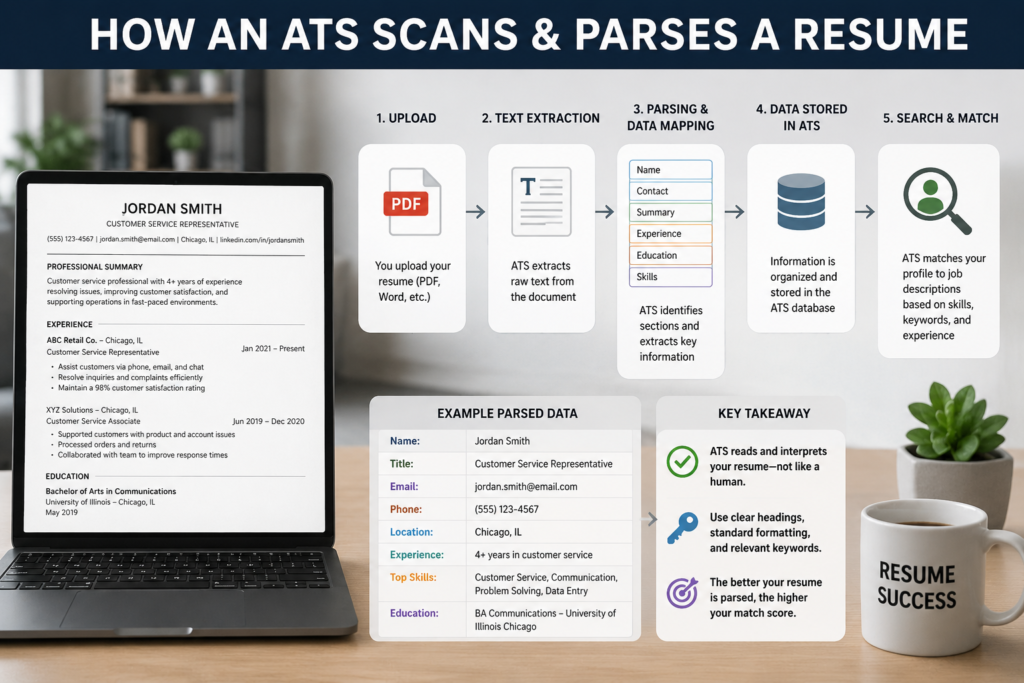
Most medium and large retail employers in the United States use scanning software called Applicant Tracking Systems (ATS) to filter out unqualified applicants. If your resume does not contain the specific keywords found in the job description, a human may never read it.
How to Pass the ATS Screening:
Read the Job Description Carefully: Identify repeating terms like “POS terminal,” “customer-facing,” “balanced drawer,” or “multitasking.”
Integrate Keywords Naturally: Do not just copy and paste keywords into a hidden block of text. Weave them smoothly into your professional summary, skills section, and work history.
Avoid Complex Formatting: ATS systems struggle to read tables, text boxes, graphics, and unconventional fonts. Stick to clean formatting and standard fonts like Arial, Calibri, or Times New Roman.
Save as a Compatible File: Unless specified otherwise, save and upload your resume as a PDF or Microsoft Word (.docx) file.
6. Education and Certifications Sections
While a formal degree is rarely required for a cashier position, formatting this section correctly shows professionalism and completeness.
Education Section Layout
List your highest level of education first. If you have a college degree or are currently enrolled, you can omit your high school diploma.
High School Diploma | Oak Creek High School, Milwaukee, WI (Graduated June 2023)
Associate of Arts in Business Administration (In Progress) | Santa Monica College, CA
Value-Adding Certifications
If you want to stand out from other applicants, adding relevant certifications can give you a significant edge, especially in food retail or environments serving alcohol.
ServSafe Food Handler Certification (Crucial for grocery store and fast-food cashiers)
State-Specific Alcohol Server Certification (Important for supermarkets, restaurants, or liquor stores)
Customer Service Excellence Certificate
7. Action Verbs to Make Your Resume Stand Out
Do not start every bullet point in your work history with “Responsible for.” Instead, use energetic, impactful action verbs that paint a picture of an active, efficient worker.
Processed payments accurately.
Reconciled cash drawers at the end of shifts.
Upsold store warranties and promotions.
Resolved customer complaints gracefully.
Streamlined checkout queues during peak holiday hours.
Maintained pristine visual merchandising standards near registers.
Collaborated with floor managers to manage inventory shortages.
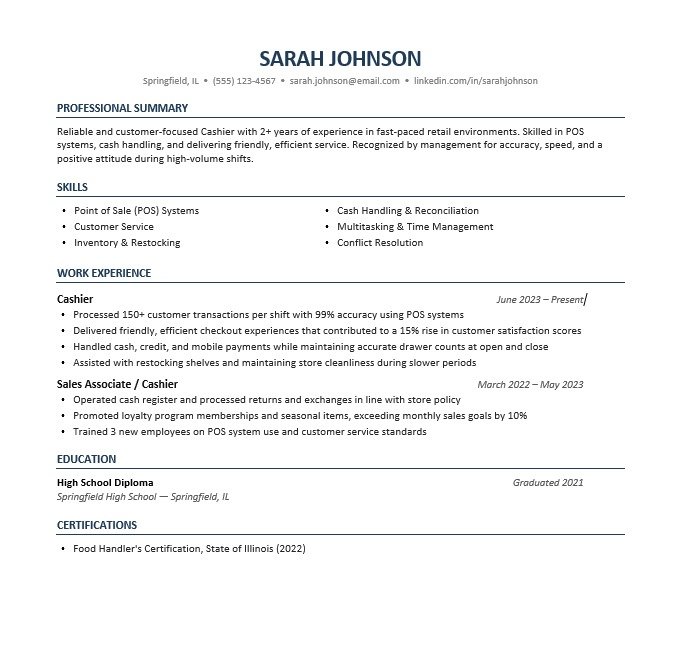
8. Cashier Resume Examples for Different Scenarios
To help you get started, here are two practical, real-world examples that you can adapt to your own background.
9. Final Proofreading and Polish Checklist
Before you send your resume to a hiring manager or upload it to a corporate site, go through this checklist to make sure your application is perfect:
[ ] Check for Typos: Misspelling “cashier” or “customer” is an immediate red flag. Read your resume backward to catch sneaky errors.
[ ] Verify Contact Info: Make sure your phone number is correct and your email address is professional (e.g.,
firstname.lastname@email.com).[ ] Keep it to One Page: For a standard cashier position, your resume should fit completely on a single page. Cut out irrelevant or repetitive information.
[ ] Match the Job Ad: Ensure the top keywords from the employer’s listing appear somewhere in your text.
How to Write a Cover Letter for Retail Jobs
10. Frequently Asked Questions (FAQs)
What should an entry-level cashier put on their resume?
If you don’t have experience, focus on your education, volunteer work, clubs, sports teams, or any activity where you handled responsibility, interacted with people, or managed money. Highlight soft skills like reliability, quick learning, and honesty.
How do I write that I can handle cash on a resume?
Instead of just saying “cash handling,” use terms like “processed payments,” “accurately balanced drawers,” “reconciled daily cash receipts,” “managed cash, credit, and digital transactions,” and “maintained a $0 variance record.”
What is the best font size for a cashier resume?
Use a font size between 10 and 12 points for the body text, and between 14 and 16 points for your section headings. This ensures your resume remains easily readable for both humans and ATS machines.
By formatting your document cleanly, emphasizing your quantifiable achievements, incorporating essential keywords, and tailoring it specifically to the job description, you will stand out in the applicant pool. Take the time to polish your resume, and you’ll be well on your way to securing interviews with top US employers.