
Avoid these critical career mistakes when applying for jobs in the U.S. Learn about ATS resumes, cultural fit, and networking to boost your success.
Career Mistakes That Can Hurt Your Job Chances in the U.S.
The United States job market is one of the most competitive and dynamic in the world. For many professionals, landing a role in a U.S.-based company is a dream come true. However, the path to success is riddled with “silent killers”—common career mistakes that can disqualify even the most talented candidates before they even get an interview.
In this comprehensive guide, we will dive deep into the specific mistakes you must avoid and how to navigate the American corporate landscape like a pro.
1. Ignoring the Applicant Tracking System (ATS)
One of the biggest mistakes international and even local candidates make is submitting a resume that isn’t optimized for the Applicant Tracking System (ATS).
Why it matters:
Over 95% of Fortune 500 companies use ATS software to filter resumes. If your resume contains complex graphics, tables, or non-standard fonts, the system might fail to read your data, leading to an automatic rejection.
How to fix it:
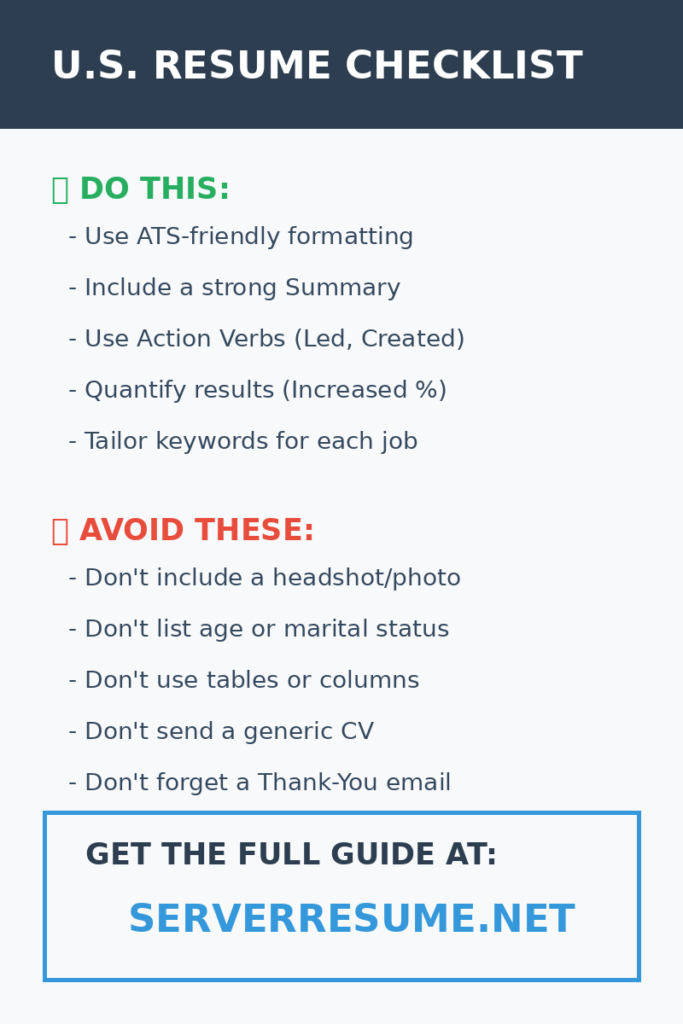
- Use a clean, single-column layout.
- Stick to standard fonts like Arial or Calibri.
- If you want to master this, check out our The Ultimate Resume ATS Ebook for a step-by-step formatting guide.
2. Including Personal Information (The Bias Rule)
In many countries, it is normal to include your photo, age, marital status, or religion on a CV. In the U.S., this is a huge mistake.
The Legal Reason:
U.S. employers are bound by strict anti-discrimination laws enforced by the U.S. Equal Employment Opportunity Commission (EEOC). To avoid potential lawsuits, recruiters often discard resumes that contain personal photos or protected demographic information immediately.
3. Lack of Cultural Fit and Soft Skills
American recruiters don’t just hire for technical skills; they hire for “Cultural Fit.”
Common Mistakes:
- Being too humble: In the U.S., you are expected to “sell” yourself. Failing to highlight your individual achievements (using “I” instead of “We”) can make you seem less confident.
- Poor Networking: In the U.S., up to 80% of jobs are filled through networking and are never even posted online.
Strategy:
Build a strong profile on LinkedIn and connect with professionals in your target industry.
4. Generic Cover Letters
Sending the same cover letter to 50 different companies is a recipe for failure. American managers look for a “Why us?” factor.
The Fix:
Tailor every cover letter. Mention a specific project the company recently completed or a value they hold that resonates with you.
5. Overlooking the “Action Verbs” in Your Resume
Using passive language like “I was responsible for…” is a weak way to describe your experience.
Use Power Verbs Instead:
Instead of “Managed a team,” use “Spearheaded a cross-functional team of 10 to increase revenue by 20%.”
6. Neglecting Your Digital Footprint
Before an offer is made, 70% of employers screen candidates’ social media profiles.
Mistake:
Having unprofessional public posts on Facebook or Twitter can hurt your chances.
Fix:
Set your personal accounts to private and ensure your LinkedIn is professional, updated, and has a high-quality headshot.
7. Poor Follow-Up Etiquette
In the U.S. business culture, following up is seen as a sign of interest and professionalism, not desperation.
The Mistake:
Failing to send a “Thank You” email within 24 hours of an interview. This small gesture can often be the tie-breaker between two equal candidates
8. Misunderstanding the “Star” Method
During interviews, Americans love stories. A common mistake is giving vague answers to behavioral questions (e.g., “Tell me about a time you failed”).
The Solution:
Use the STAR Method:
- Situation: Set the scene.
- Task: Describe the challenge.
- Action: What did you do?
- Result: What was the positive outcome?
The American job market is challenging, but by avoiding these common pitfalls—especially the technical ones like ATS optimization—you significantly increase your odds. Remember, your resume is your first impression. Make it count.
Ready to take the next step? Don’t let a machine reject your application. Download our Ultimate ATS-Friendly Resume Guide today and start landing interviews!