

Learn how to explain a resume gap in 2026 or layoff with honest, confident strategies that keep employers focused on your value.
How to Explain a Resume Gap or Layoff in 2026 (Without Hurting Your Chances)
A resume gap can feel bigger than it actually is.
In 2026, however, career interruptions are increasingly common across the US job market. Layoffs, caregiving, education, relocations, and personal priorities can all interrupt employment.
Therefore, you do not need to treat a gap like a confession.
Instead of that, present the situation clearly, briefly, and confidently. Then, redirect attention toward your current skills and career goals.
The key is simple: explain the timeline without letting it define your professional story.

Why Employment Gaps Are More Common in 2026 (And Why Employers Know It)
The US labor market continues to change quickly.
Companies restructure teams, eliminate positions, consolidate departments, and adjust hiring plans as recent BLS employment data shows.
Consequently, qualified professionals can lose jobs through circumstances beyond their control.
A layoff does not automatically indicate poor performance.
Similarly, taking a break from work for several months does not erase your experience.
Employers also understand that modern careers rarely follow perfectly straight paths, In fact, SHRM’s 2026 Talent Trends research found that 68% of HR professionals reported difficulty recruiting full-time employees. People may pause employment for family responsibilities, professional development, relocation, or recovery.
That context matters when you approach a resume gap 2026 situation.
You should still take responsibility for explaining your timeline. However, you do not need to apologize for it.
Instead, focus on three things:
- What happened.
- What you did during the period.
- Why you are ready for the role now.
For example, a six-month gap after a company-wide reduction needs little explanation.
You can state that your position ended during a workforce reduction. Then, highlight your current qualifications.
The same principle applies to longer gaps.
Your goal is not to eliminate every question. Your goal is to make the answer easy to understand.
Should You List the Gap on Your Resume or Address It in the Interview?
You usually do not need to label an employment gap directly.
Instead, build an accurate timeline using years or months consistently.
For example:
Marketing Manager | ABC Company | March 2022–September 2025
Professional Development | October 2025–March 2026
That approach provides context without creating a large visual gap.
But don’t invent a job title to cover up unemployment.
You should never describe independent work as employment unless you actually performed that work.
If you completed courses, freelanced, volunteered, consulted, or built projects, include those activities when relevant.
For example:
Career Development | October 2025–March 2026
- Completed advanced analytics coursework.
- Built three portfolio projects.
- Provided freelance reporting support for small businesses.
This format works especially well for an employment gap resume 2026.
During interviews, answer questions directly.
Avoid giving a five-minute explanation when two sentences will work.
A strong answer usually follows this structure:
Situation → Productive action → Current readiness
For example:
“My position ended during a company-wide restructuring. I used the transition to strengthen my analytics skills, and I am now focused on applying them in a full-time marketing role.”
That answer sounds prepared rather than defensive.
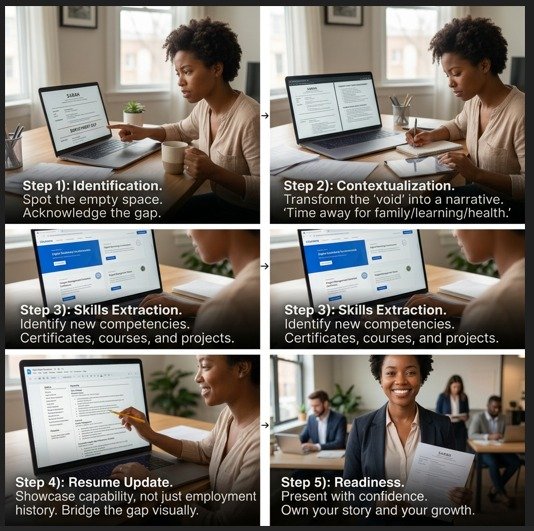
How to Frame a Resume Gap: 8 Practical Steps
1. Identify the Real Reason for the Gap
Start with the truth.
Was the gap caused by a layoff, caregiving, education, relocation, health needs, or a career decision?
You do not need to disclose private details.
However, you should understand your own interpretation before conducting the interview.
A clear reason makes your answer shorter and more confident.
2. Keep the Explanation Brief
Most employers do not need your complete personal history.
Give enough information to establish context.
For example:
“My role ended during a broader workforce reduction.”
Or:
“I stepped away from full-time work to provide family caregiving support.”
Then move forward.
Do not spend most of your interview discussing the gap.
3. Explain What You Did During the Time
A gap does not necessarily mean professional inactivity.
You may have learned software, completed training, managed projects, volunteered, freelanced, or searched for the right opportunity.
Mention relevant activities first.
For example:
“During that period, I completed a project management certification and supported two nonprofit projects.”
That information adds evidence of initiative.
4. Connect the Experience to the Target Job
This step makes your explanation stronger.
Do not simply list activities.
Show how they support your next role.
For example:
“I used that time to improve my SQL skills, which directly supports the reporting responsibilities in this position.”
That connection gives your gap a professional context.
5. Avoid Negative Language About Your Former Employer
When explaining a layoff, remain factual.
Do not criticize executives, recruiters, managers, or company finances.
Instead, say:
“The company eliminated several positions during a restructuring.”
Then stop.
This approach answers how to explain a layoff on resume questions without sounding bitter.
6. Show That Your Skills Remain Current
Longer gaps can create concerns about outdated skills.
Address that concern proactively.
Mention recent certifications, projects, tools, industry reading, professional communities, or contract work.
For example:
“I continued using Salesforce through volunteer consulting projects while I searched for my next full-time role.”
Specific evidence works better than vague claims.
7. Prepare One Consistent Interview Answer
Your resume, LinkedIn profile, and interview answers should not contradict each other.
Prepare a short explanation before applying.
Practice saying it naturally.
But avoid memorizing every single word.
You want to sound confident, not rehearsed.
For additional guidance, review these preparing for interviews in 2026 strategies.
8. End With Your Readiness
Always bring the conversation back to the future.
For example:
“That transition is behind me, and I am ready to bring my experience to a team where I can contribute immediately.”
This final sentence changes the focus.
You are no longer discussing what happened.
You are discussing what you can deliver.
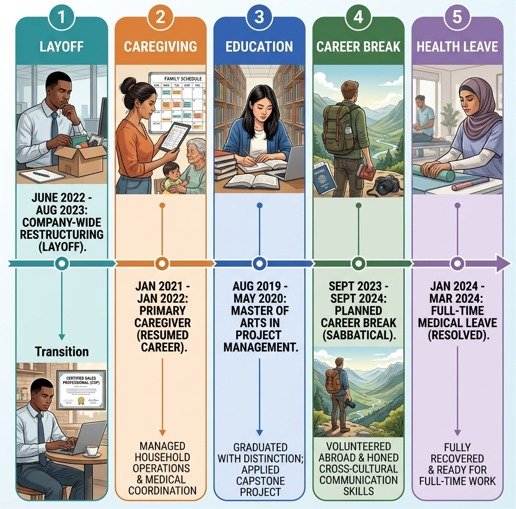
Resume Gap Examples for Common Situations
Different gaps require different explanations.
However, every explanation should remain honest, concise, and forward-looking.
Layoff
A layoff generally requires the least personal detail.
Example:
“My position ended in a company-wide reduction in force. Since then, I have focused on targeted applications and strengthening my data analysis skills.”
You do not need to defend your performance unless asked.
If performance becomes a question, answer with documented facts.
Caregiving
Caregiving represents a legitimate career interruption.
You can protect your privacy while providing useful context.
Example:
“I took time away from full-time employment to provide family caregiving support. I am now ready to return to a full-time role.”
You do not need to disclose medical information about yourself or another person.
Health-Related Break
You control how much personal information you share.
Keep the explanation professional and focused on your ability to work now.
Example:
“I took a temporary personal leave and am now fully prepared to return to my career.”
If your health history is irrelevant to the job, do not provide unnecessary details.
Career Break
Some professionals intentionally step away from traditional employment.
That might involve travel, personal priorities, entrepreneurship, or reassessing career direction.
Example:
“I took a planned career break to reassess my goals and develop new technical skills. I am now focused on returning to operations leadership.”
A purposeful explanation can sound stronger than an apologetic one.
Education or Training
Education provides a straightforward explanation.
Example:
“I stepped away from full-time employment to complete a graduate certificate in cybersecurity.”
Then connect the education to the target position.
For instance:
“The program strengthened my security analysis and risk assessment skills.
For more guidance on presentation, review these common resume mistakes before submitting applications.
Mistakes to Avoid When Explaining a Gap
Your explanation can fail when you overcorrect.
Use this checklist before submitting your resume or entering an interview.
✅ Do
- Keep your explanation honest.
- Use consistent dates throughout your application.
- Highlight relevant activities during the gap.
- Mention recent training when appropriate.
- Focus on skills that remain current.
- Keep layoff explanations factual.
- Protect private personal information.
- Practice a concise interview response.
- Connect your experience to the target position.
- End by emphasizing your readiness.
❌ Don’t
- Invent employment to hide a gap.
- Blame your former employer.
- Overexplain personal circumstances.
- Disclose unnecessary medical information.
- Sound apologetic about caregiving.
- Describe unemployment as professional failure.
- Use vague claims without evidence.
- Change your explanation between applications.
- Let the gap dominate your interview.
- Assume employers will reject you automatically.
A strong resume gap 2026 strategy treats the gap as context.
Your qualifications should remain the main story.
Your resume should also make those qualifications easy to find.
Take the advice, and use clear headings, concise and brief bullet points, job-related keywords, and a consistent timeline.
An ATS-friendly resume can help recruiters identify your relevant experience faster.
Frequently Asked Questions
1. Should I explain a resume gap directly on my resume?
Usually, you do not need a sentence explaining unemployment.
in place of, create an accurate timeline and include relevant activities.
Address the reason directly when an application or interviewer asks.
nevertheless, longer gaps may benefit from a short “Career Break” or “Professional Development” entry.
For additional guidance, Indeed’s guide to explaining employment gaps offers practical advice on presenting gaps clearly and focusing on relevant skills.
2. How should I explain being laid off during an interview?
Keep the explanation factual and short.
For example:
“My role was eliminated during a company restructuring. I used the transition to strengthen my skills, and I am now focused on finding a long-term opportunity.”
Avoid blaming the company.
Then quickly shift toward your qualifications and results.
3. Will a resume gap hurt my chances in 2026?
A gap can raise questions, but it does not automatically eliminate you.
Recruiters typically evaluate the complete candidate profile.
Your recent skills, relevant accomplishments, career direction, and interview performance all matter.
accordingly, focus on making those strengths obvious.
4. What should I put on my resume during unemployment?
Include legitimate activities that strengthen your candidacy.
These can include certifications, courses, freelance work, consulting, volunteer projects, portfolios, or relevant professional projects.
Do not add activities simply to fill space.
Every entry should support your professional story.
5. How long is too long for an employment gap?
There is no universal cutoff.
A three-month gap and a two-year gap may require different levels of explanation.
Nevertheless, the same strategy applies.
Explain the period honestly, highlight productive activities, and demonstrate current readiness.
The goal is not to pretend the gap never happened.
The goal is to show why it does not prevent you from succeeding now.
Get Your Free Resume Template →
Get Your Free Resume Template →
Own the Timeline and Focus on What Comes Next
A resume gap does not define your career.
Neither does a layoff.
In a changing job market, employment interruptions can happen to capable professionals for many reasons.
Therefore, do not approach your gap with embarrassment.
Approach it with clarity.
Explain what happened without unnecessary detail. Then, show what you did, what you learned, and what you can contribute today.
If you are dealing with a resume gap 2026, prepare your explanation before submitting applications.
Keep your resume accurate.
Keep your interview answer concise.
Most importantly, keep the focus on your current value.
Your next employer is hiring you for what you can accomplish in the future.
Let your resume and interview make that case clearly